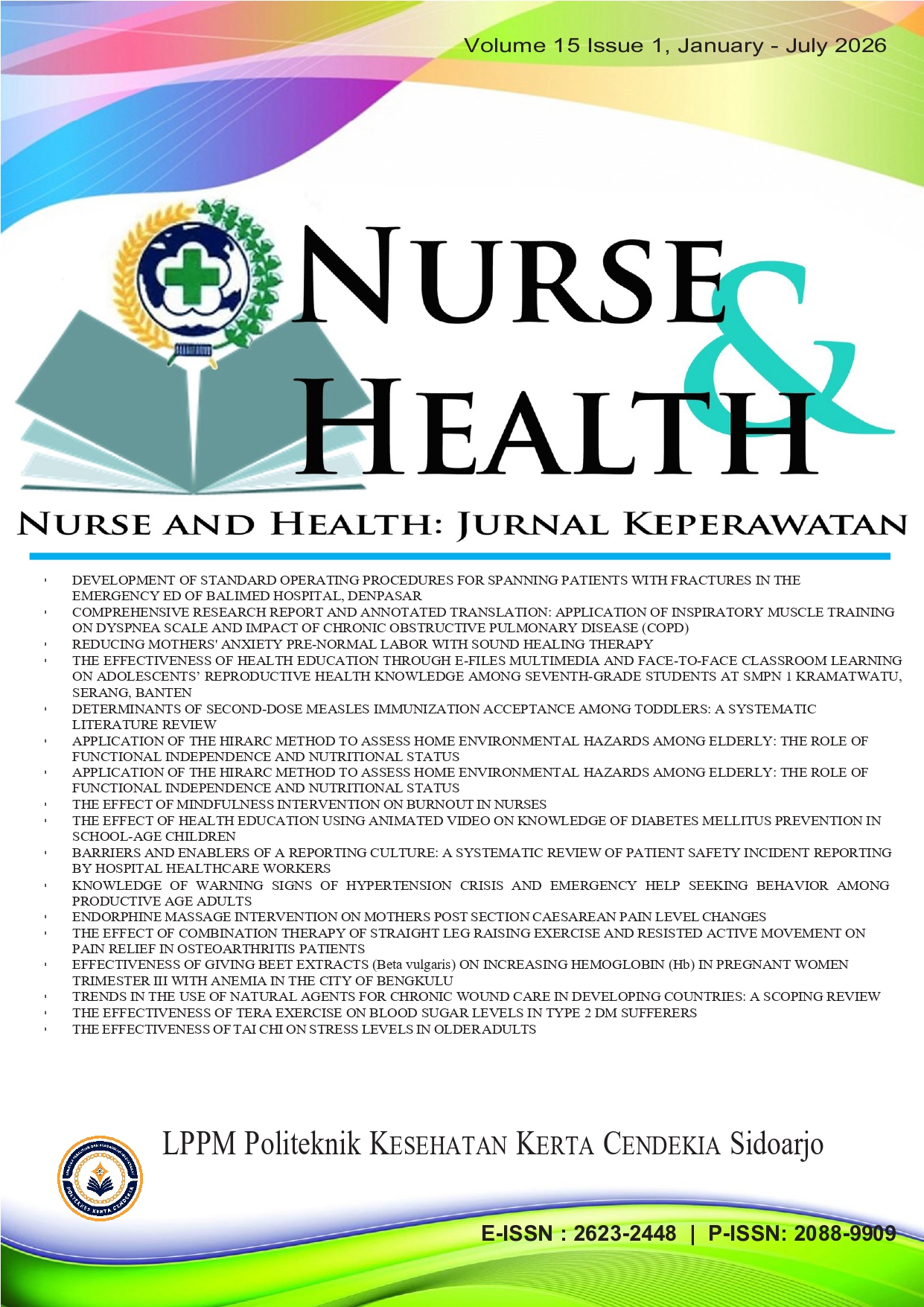
THE EFFECTIVENESS OF HEALTH EDUCATION THROUGH E-FILES MULTIMEDIA AND FACE-TO-FACE CLASSROOM LEARNING ON ADOLESCENTS’ REPRODUCTIVE HEALTH KNOWLEDGE AMONG SEVENTH-GRADE STUDENTS AT SMPN 1 KRAMATWATU, SERANG, BANTEN
DOI:
https://doi.org/10.36720/nhjk.v15i1.881Keywords:
Adolescent Knowledge about Reproductive Health, E-File Multimedia, Face-to-FaceAbstract
Background : Adolescence is a transitional period between childhood and adulthood. During this time, many changes occur in adolescents, including physical changes, puberty, and behavior. Globally, health issues among adolescents are primarily driven by risky behaviors such as unhealthy dating, smoking, alcohol consumption, and drug use, which have become major concerns worldwide. This research aims to prove the influence of Health Education through Multimedia E-Files and Face-to-Face Learning in the Classroom on Adolescent Reproductive Health Knowledge.
Methods: The research design is a Quasi-Experimental Design with a pretest-posttest control group design. The sample consists of seventh-grade students from SMP Negeri 1 Kramatwatu, with 45 respondents in the control group and 45 respondents in the experimental group, using probability sampling with proportional random sampling method. Data analysis was conducted using Wilcoxon and Mann-Whitney tests.
Results: Indicate an effect of reproductive health education through E-File Multimedia media on adolescents' reproductive health knowledge. The average N-Gain Score in the control group was 31.33, while in the experimental group, it was 59.34.
Conclusion : Future research is expected to implement different interventions regarding the TRIAD KRR in adolescents and enhance the effectiveness of other media or expand this research with different variables to provide the latest innovations in health education.
Downloads
References
Ardhianti, F. v1i1. 95. (2022). Efektifitas Penggunaan Video Sebagai Media Pembelajaran Untuk Siswa Sekolah Dasar. Nautical. Jurnal Ilmiah Multidisiplin Indonesia, 1(1), Pp. 5–8. Available at: Https://Doi.Org/10.55904/Nautical.V1i1.95., 1(1), 5–8. https://doi.org/10.55904/nautical.v1i1.95.
Aziz, A. . (2021). Penerapan Program Generasi Berencana (GenRe) Di Kota Palembang. Jurnal Ilmu Administrasi Negara, 19(3).
Badan Pusat Statistik. (2020). Survei Demografi dan Kesehatan Indonesia.
Berencana, B. K. dan K. (2021). Kesehatan Reproduksi Dan Nikah Dini.
Efanti, E. (2018). Pengaruh Pelatihan Pendidikan Kesehatan Terhadap Kompetensj Perawat Dan Kepuasan Pasien Di Ruang Perawatan Rumah Sakit Syarif Hidayatulah. Jurnal Hospitalia, 1(1).
Herawati, N., Kusmaryati, P. dan Wuryandari, A. G. (2022). Audio Visual Dan Power Point Sebagai Media Edukasi Dalam Merubah Pengetahuan Dan Perilaku Remaja. Jurnal Keperawatan Silampari, 6(1), Pp. 145–152., 6(1), pp 145-152.
Kementerian Kesehatan Republik Indonesia. (2020). Infodatin Pusat Data Dan Informasi Kementerian Kesehatan RI. Kementerian Kesehatan Republik Indonesia. Jakarta Selatan. https://pusdatin.kemkes.go.id/resources/download/pusdatin/infodatin/infod atin-2020-HIV.pdf.
Newman dan Newman. (2017). “Development Through Life: A Psychosocial Approach” ((13th ed.)). Cengage Learning.
Oktaviani, R. T. /ejournal. perpusnas. go. id/md/article/view/728. (2019). Pemanfaatan Video Sebagai Media Pembelajaran Dalam Pendidikan Dan Pelatihan. Jurnal MADIKA: Media Informasi Dan Komunikasi Diklat Kepustakawanan, 5(1), Pp. 91–94. Available at: Https://Ejournal.Perpusnas.Go.Id/Md/Article/View/728., 5(1), 91–94.
Organization, W. H. (2021). Adolescent and young adult health. https://www.who.int/news-room/fact-sheets/detail/adolescents-health- risks-and-solutions %0A
Rahmah, D. N., Setiono, K. W., dan Telusa, A. S. (2021). Efektivitas Media Video Terhadap Peningkatan Pengetahuan Pencegahan Covid-19 Pada Mahasiswa Baru Universitas Nusa Cendana. Cendana Medical Journal (CMJ), 9(1), 46-57., 9(1), 46–57.
Rahyani, N. K. Y. (2014). Strategi Pengendalian HIV/AIDS Pada Remaja Berbasis Sekolah di Bali. Kebijakan AIDS Indonesia.
Roy, D., Tripathy, S., Kar, SK., Sharma, N., Verma SK., dan Kaushal, V. 2. (2020). Roy, D., Tripathy, S., Kar, SK., Sharma, N., Verma SK., dan Kaushal, V. 2020. Study of knowledge, attitude, anxiety & perceived mental healthcare need in Indian population during COVID-19 pandemic. Asian J Psychiatr. Jun;51:102083. Doi: 10.1016/j.Ajp.2020.102083. Epub 2020 Apr 8. PMID: 32283510; PMCID: PMC7139237.
Saifuddin, A. (2016). Buku Panduan Praktis Pelayanan Kesehatan Maternal. danNoeonatal. Yayasan Bina Pustaka Sarwono Prawiharohardjo.
Setiowati, D. (2014). Efektivitas Pendidikan Kesehatan Reproduksi Terhadap Peningkatan Pengetahuan Remaja Di Smk Islam Wijaya Kusuma Jakarta Selatan. Jurnal Keperawatan Soedirman (The Soedirman Journal of Nursing), 9(2), Pp. 86–93. Available at: Http://Jks.Fikes.Unsoed.Ac.Id/Index.Php/Jks/Article/View/565., 9(2), 86–93. http://jks.fikes.unsoed.ac.id/index.php/jks/article/view/565.
Shorayasari, S., Effendi, D. dan Puspita, S. (2017). Difference Knowledge After Given Health Education About Rubing Dental With Video Modeling. Jurnal Ilmu Kesehatan Masyarakat, 8(1), Pp. 43–48. Available at: Https://Doi.Org/10.26553/Jikm.2017.8.1.43-48., 8(1), 43–48.
Tafonao, T. (2018). Peranan Media Pembelajaran Dalam Meningkatkan Minat Belajar Mahasiswa. Jurnal Komunikasi Pendidikan, 2(2)., 2(2).
Downloads
Published
How to Cite
Issue
Section
Citation Check
License
Copyright (c) 2026 Nurse and Health: Jurnal Keperawatan

This work is licensed under a Creative Commons Attribution-NonCommercial-ShareAlike 4.0 International License.
Authors who publish with Nurse and Health: Jurnal Keperawatan agree to the following terms:
- Authors retain copyright licensed under a Creative Commons Attribution-NonCommercial 4.0 (CC BY-NC 4.0), which allows others to remix, tweak, and build upon the authors' work non-commercially, and although the others' new works must also acknowledge the authors and be non-commercial, they don't have to license their derivative works on the same terms.
- Authors are permitted and encouraged to post their work online (e.g., in institutional repositories or on their website) prior to and during the submission process, as it can lead to productive exchanges, as well as earlier and greater citation of published work (See The Effect of Open Access). Authors can archive pre-print and post-print or publisher's version/PDF.